

Located on the turquoise shores of the Mediterranean, Fethiye is a fascinating destination not only for its natural beauty but also for its thousands of years of history. Today known as a holiday paradise, this special region is actually the heir to a deeply rooted civilization. The history of Fethiye has a multilayered past that begins in ancient times and extends through the Lycian civilization, Persian rule, the Roman and Byzantine periods, the Anatolian beyliks, and the Ottoman Empire. In this article, we will examine topics of interest such as the History of Fethiye, the former names of Fethiye, and the origins of the people of Fethiye in chronological order.
Fethiye in Ancient Times: The Birth of Telmessos
The earliest known settlement history of Fethiye dates back to the 5th century BC. In ancient times, the region was known as Telmessos. This name is the most significant among the former names of Fethiye. Telmessos stood out as one of the important cities of the Lycian civilization. The Lycians, as one of the most distinctive civilizations of Anatolia, developed their own unique language, culture, and administrative system.
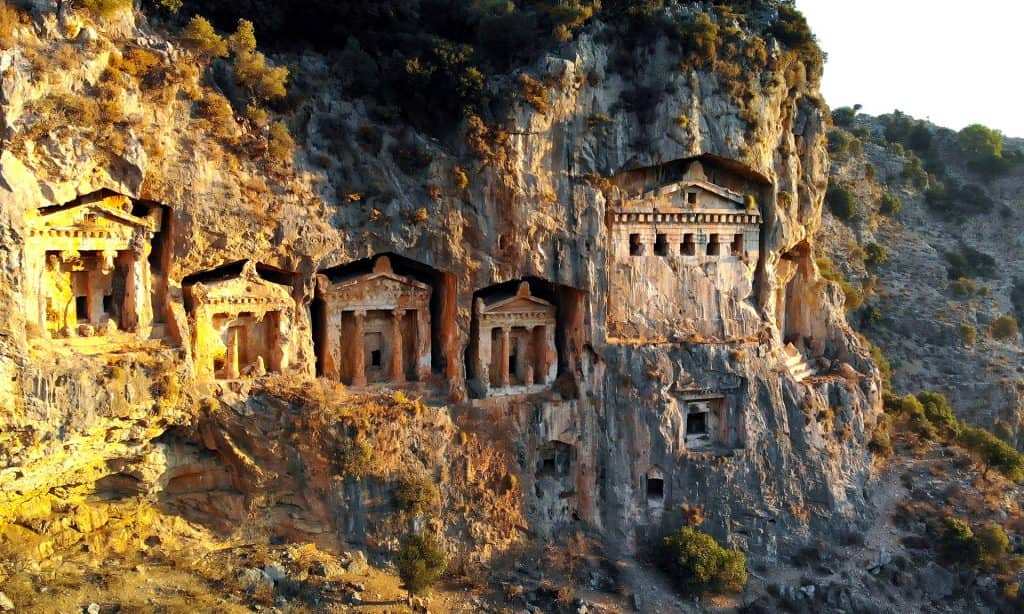
Telmessos was especially famous as a center of prophecy. According to ancient sources, the priests in the city were renowned for dream interpretation and prophecy. In this respect, the city was not only a commercial center but also a religious and cultural hub. Today, the Amyntas Rock Tombs seen in the center of Fethiye are among the most striking remains of the Lycian period and hold great importance for the history of Fethiye.
The Lycian Civilization and Fethiye
The Lycian League is one of the rare federative systems in history noted for its democratic structure. Telmessos was one of the important cities of this league. The Lycians are particularly known for their rock tombs and monumental architecture. Ancient cities such as Tlos, Xanthos, and Letoon around Fethiye reveal the richness of the region during the Lycian period.
When the history of Fethiye is examined, it is seen that the region was not merely a settlement but also a political and cultural center. The Lycians were an advanced community in maritime trade and commerce. This situation ensured that Fethiye held a strategic position throughout history.
Persian and Hellenistic Period
In the 6th century BC, like much of Anatolia, Telmessos came under the rule of the Persian Empire. The Persians largely allowed local administrations to remain autonomous, ensuring cultural continuity. During this period, the city continued its commercial activities.
Later, with Alexander the Great’s campaign in Anatolia, Telmessos entered the Hellenistic period. This era was marked by increased cultural interaction. Greek influence began to be felt in architecture, art, and urban planning. Among the former names of Fethiye, the names used after Telmessos also began to change from this period onward.
Fethiye in the Roman and Byzantine Periods
With the Roman Empire’s domination of Anatolia, Telmessos was incorporated into the Roman provincial system. During this period, the city began to be referred to as “Anastasiopolis.” This name was also used during the Byzantine period and is among the former names of Fethiye.
During the Roman and Byzantine eras, churches, baths, and public buildings were constructed in the city. Maritime trade maintained its importance. However, earthquakes and invasions caused the city to be destroyed from time to time. One of the most significant turning points in the history of Fethiye was the major earthquakes experienced in the region. These natural disasters repeatedly altered the architectural structure of the city.
The Anatolian Beyliks and the Ottoman Period
From the 13th century onward, the Anatolian Seljuk State and later the Menteşe Beylik took control of the region. During this period, Fethiye encountered Turkish-Islamic culture. Mosques, inns, and small settlements were built.
During the Ottoman Empire, the city continued to exist as an important coastal settlement. In this period, Greek and Turkish populations lived together. The origins of the people of Fethiye are largely based on this multicultural past. During the Ottoman era, Turks, Greeks, and Levantine communities lived together in the region, and trade and craftsmanship developed.
The Population Exchange and the Birth of Modern Fethiye
The Turkish-Greek population exchange carried out after the 1923 Treaty of Lausanne significantly changed the demographic structure of Fethiye. Before the exchange, Kayaköy was a large Greek settlement. After the exchange, Turkish populations from different parts of Anatolia were settled in the region.
In 1934, the city was named “Fethiye” in memory of Fethi Bey, one of the pioneers of Turkish aviation. Thus, the names Telmessos and Anastasiopolis, which were among the former names of Fethiye, became part of history. This change is considered the beginning of the city’s modern identity.
The Origins of the People of Fethiye
Today, the origins of the people of Fethiye largely trace back to Yörük-Turkmen communities. The Turkmen tribes that settled in the region during the Ottoman period formed the foundation of the cultural structure. In addition, families who arrived after the population exchange also contributed to the social fabric of the city.
The local culture of Fethiye has a rich heritage with its folk music, traditional cuisine, and handicrafts. Traces of Yörük culture can still be seen especially in plateau life and festivals. This cultural diversity holds an important place within the history of Fethiye.
Earthquakes and the Reconstruction Process
Throughout its history, Fethiye has experienced many major earthquakes. The large earthquake that occurred in 1957 destroyed a significant part of the city. After this disaster, the city was rebuilt and a modern settlement plan was established.
This reconstruction process determined the present-day urban fabric of Fethiye. While historical remains were preserved, new residential areas were developed in a planned manner.
Fethiye Today: The Meeting Point of History and Tourism
Today, Fethiye is one of Turkey’s most important tourism centers with both its historical and natural beauties. In addition to natural areas such as Ölüdeniz, Butterfly Valley, and Saklıkent, historical sites such as the Amyntas Rock Tombs and Kayaköy offer visitors a combination of past and present.
Modern Fethiye continues to carry the legacy of ancient Telmessos. With its cultural richness inherited from the past, the city offers a unique experience both for history enthusiasts and for holidaymakers.