

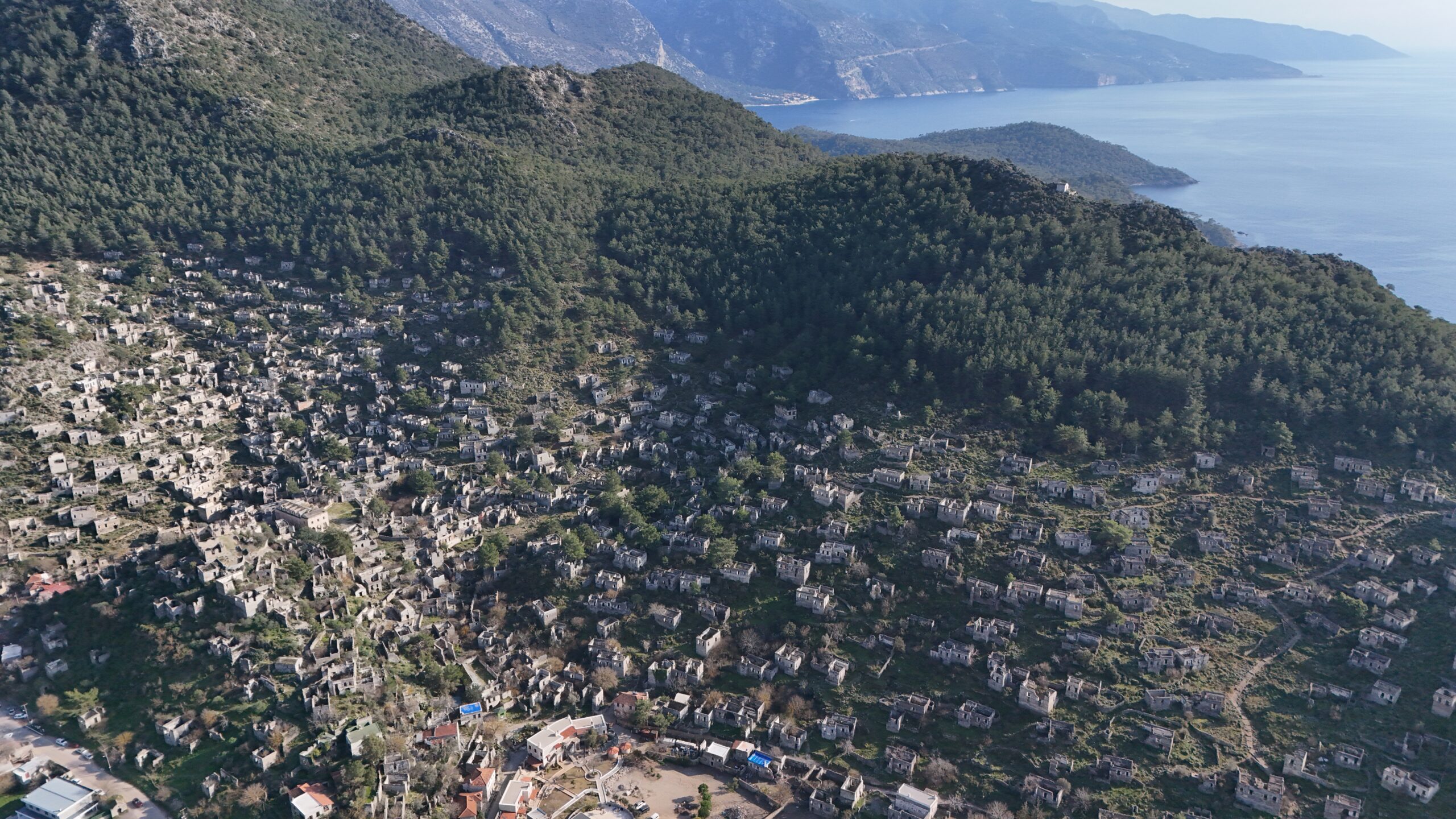
Kayaköy is called a ghost village for a reason that fits in one sentence: the town that stood here — Levissi, home to thousands — was emptied in a single stroke by the 1923 population exchange, and it never filled again. Hundreds of roofless stone houses climb the hillside, alongside two churches, scattered chapels and a school: the skeleton of a town that has been waiting a century for its doors to open. This article does two jobs. First it tells the story — life in Levissi before 1923, the days of the exchange, the 1957 earthquake. Then it gives you everything needed to plan a visit today: hours, tickets, parking, a 90-minute route and local tips. We live a few hundred metres from the ruins and walk these lanes in every season; what follows is written from the ground.
In this guide
- Why was Kayaköy abandoned?
- Levissi: life before 1923
- 1923: the exchange
- 1957 and after
- What you see today
- Visitor information: hours, tickets, parking
- A suggested 90-minute route
- Kayaköy in fiction and film
- Sleeping among the stones
- Frequently Asked Questions
Why was Kayaköy abandoned?
Two dates emptied Kayaköy. The first is 1923: under the population exchange agreed in the Treaty of Lausanne, Levissi’s Greek Orthodox inhabitants were sent to Greece. The Muslim exchange families who arrived in their place chose the fertile plain below rather than the dry, steep hillside, so the town stood empty. The second is 1957: the earthquake that struck Fethiye brought down the roofs and floors of buildings that had gone three decades without care. What remained is the view you see today — a town with its walls standing and its interiors open to the sky. The area has been protected since 1988 and is now visited as an open-air museum under the Ministry of Culture and Tourism.
Levissi: life before 1923
Through the nineteenth and early twentieth centuries Levissi was a prosperous town of thousands, with its own schools, churches, a pharmacy and workshops. Its people were mostly craftsmen and traders — blacksmiths, shoemakers, carpenters — while Turkish farmers worked the Kaya plain below; the two communities met at the market, at harvest, at weddings. The houses were set on the slope so that no home blocked another’s view of the plain and the sea — a courtesy you can still read in the lanes today, and the signature of Levissi’s town planning. Cisterns under the houses collected rainwater, street fountains served each neighbourhood, and the fountain on the square carries the date 1888.
1923: the exchange
After the war, Turkey and Greece agreed at Lausanne to exchange populations: Greek Orthodox communities of Anatolia would go to Greece, Muslim communities of Greece would come to Turkey. For the people of Levissi this meant leaving houses their families had held for generations, their gardens and the graves of their dead. Most of the departing families settled near Athens, and gave one of the neighbourhoods they founded the name of their lost home town. The exchange families arriving in the other direction settled on the plain rather than the hillside. And so the town emptied — not by war, not by fire, but by the stroke of a treaty. That is what separates Kayaköy from other abandoned places, and what makes its silence so heavy.
1957 and after
In April 1957 a major earthquake struck Fethiye. The timber roofs and floors of Levissi’s houses, unmaintained for more than thirty years, collapsed; the stone walls held. The town took on the open-roofed form it has today. In the decades that followed the site was defended against treasure hunters and time, and in 1988 it was placed under protection. Restoration debates surface from time to time, but the spirit of the place has not changed: Kayaköy is not a rebuilt film set but a place of memory, left as it is.
What you see today
- The lower church. The town’s main church and the largest building on the site, with a broad courtyard and traces of fresco visible from outside. The churches are kept locked for protection; you walk the facades and courtyards.
- The upper church. High in the ruins; the climb is steep and the view is the best on the site — the whole town, the Kaya plain and the ridges running to the sea.
- The chapels. Small chapels scattered across the slope; in some, paint can still be made out inside the domes.
- The school building. In the lower town, a witness to Levissi’s civic life.
- Lanes, cisterns, fountains. The real experience is not building by building but lane by lane: door thresholds, hearth niches, traces of limewash, the mouths of cisterns beneath the houses and the fountain dated 1888.
- Sunset. In summer the site stays open until 19:30, so the last hour catches the light that turns the stone to honey.
Visitor information: hours, tickets, parking
| Item | Details |
|---|---|
| Opening hours | Summer season (1 April – 31 October) 08:30–19:30 · Winter 08:30–17:30 |
| Ticket office | Stops selling about 30 minutes before closing |
| Tickets | Turkish MüzeKart valid for Turkish citizens; a small fee for foreign visitors (check the current price at the gate or on official channels) |
| Entrances | Two gates; entering from the village-square side and climbing is the most natural route |
| Parking | Free areas near the main entrance; they fill on summer middays, so come early |
| Time needed | 2–3 hours at an easy pace; half a day with the climb to the upper church |
| Footwear | Closed shoes; the stone is slippery, especially after rain |
| Rules | No climbing on the buildings, no removing stones, no unauthorised drone flights |
For getting here without a car, the dolmuş from Fethiye runs roughly hourly from the bus station.
A suggested 90-minute route
- Village-square entrance (0 min). Buy your ticket, look at the fountain, start up the main lane.
- The lower church (15 min). Stand in the courtyard; this is where the scale of the town first lands.
- The middle lanes (35 min). Leave the main path and take the side lanes — the hearth niches, cistern mouths and thresholds are here, and even on busy days the side lanes are empty.
- The upper church (60 min). The steep climb pays in the view; the right place for a water stop.
- The chapel ridge and the descent (75–90 min). Come down past the chapels on the western ridge to the second gate. From here, walkers can join the walk to Ölüdeniz that starts at the ruins; everyone else can head back to the square for the stone-courtyard restaurants.
The two best windows for photography are the first hour of the morning and the hour before closing; midday light flattens the stone.
Kayaköy in fiction and film
The town of Eskibahçe in Louis de Bernières’s novel Birds Without Wings was inspired by Kayaköy; the book tells of the intertwined lives before the exchange and of the tearing apart, and many readers come to the village because of it. Scenes of Russell Crowe’s The Water Diviner (2014) were also filmed here. Both are good preparation: after them, you walk the lanes putting names behind the walls.
Sleeping among the stones
There is no accommodation inside the site, and there should not be — it is a museum. But in the living village immediately beside the ruins you can stay in houses restored with the same stonework, and this is the deepest way to understand Levissi: hearing the village go quiet after the last visitors leave, and being the first person into the ruins in the morning. We host guests in seven restored stone villas on the quiet side of the village; the story of these houses — which keep the language of Levissi’s masons, from wall texture to window proportions — is on our About Us page. Every option, from boutique hotels to pensions and villas, is compared in our guide to staying beside the ruins.
Frequently Asked Questions
Why was Kayaköy abandoned?
Under the 1923 Turkey–Greece population exchange, Levissi’s Greek inhabitants were sent to Greece; the exchange families who arrived settled on the plain rather than the hillside, so the town stood empty. The 1957 Fethiye earthquake then brought down the roofs of the unmaintained houses, creating today’s “ghost village”.
How many people lived in Kayaköy?
Levissi was a well-developed town of thousands in the early twentieth century; sources give different figures, so an exact number would be misleading. The scale is still legible on the ground: hundreds of houses on the slope, two churches, numerous chapels and a school building.
Is there an entrance fee, and is the MüzeKart valid?
Yes, entry is ticketed. Turkish citizens enter with the MüzeKart; foreign visitors pay a small fee — check the current price at the ticket office or on official channels. The office stops selling about half an hour before closing.
How long do you need for Kayaköy?
Two to three hours at an easy pace. With the climb to the upper church, the side lanes and photo stops, half a day is more enjoyable. In summer, go in the first hours of the morning or after 17:00; in spring and autumn the site is comfortable at any hour.
Can you go inside the churches?
No; the lower and upper churches are kept locked for protection. You walk their courtyards and facades, and traces of fresco can be seen from outside. In some of the small chapels on the slope, paint is still visible inside the domes.
Which book and film feature Kayaköy?
Eskibahçe, the town in Louis de Bernières’s Birds Without Wings, was inspired by Kayaköy, and scenes of The Water Diviner (2014), directed by Russell Crowe, were filmed here. Both make good preparation for a visit.
Can you visit Kayaköy at night?
No; the site closes at 19:30 in summer and 17:30 in winter, and there is no night entry. For sunset light, come in the last hour before closing in summer. The night sky belongs to the living village — watched from the terrace of wherever you are staying, Kayaköy’s stars come in numbers towns forget.
Can you stay inside the ghost village?
No; the site is a museum and has no accommodation. Visitors stay in the living village immediately beside the ruins, where boutique hotels, pensions, restored stone houses and private-pool villa stays are all within walking distance.
Conclusion
The stones of Kayaköy do not speak; but walk the right lane at the right hour and you hear what they are keeping quiet. Time your visit for the morning or the closing light, take the side lanes, climb to the upper church — and if you can, spend the night in the village. Our complete Kayaköy guide covers the whole plan, and our stay guide covers where to sleep. For those who want a few nights among Levissi’s stones rather than a day, our villas are on the quiet side of the village: reservations.