

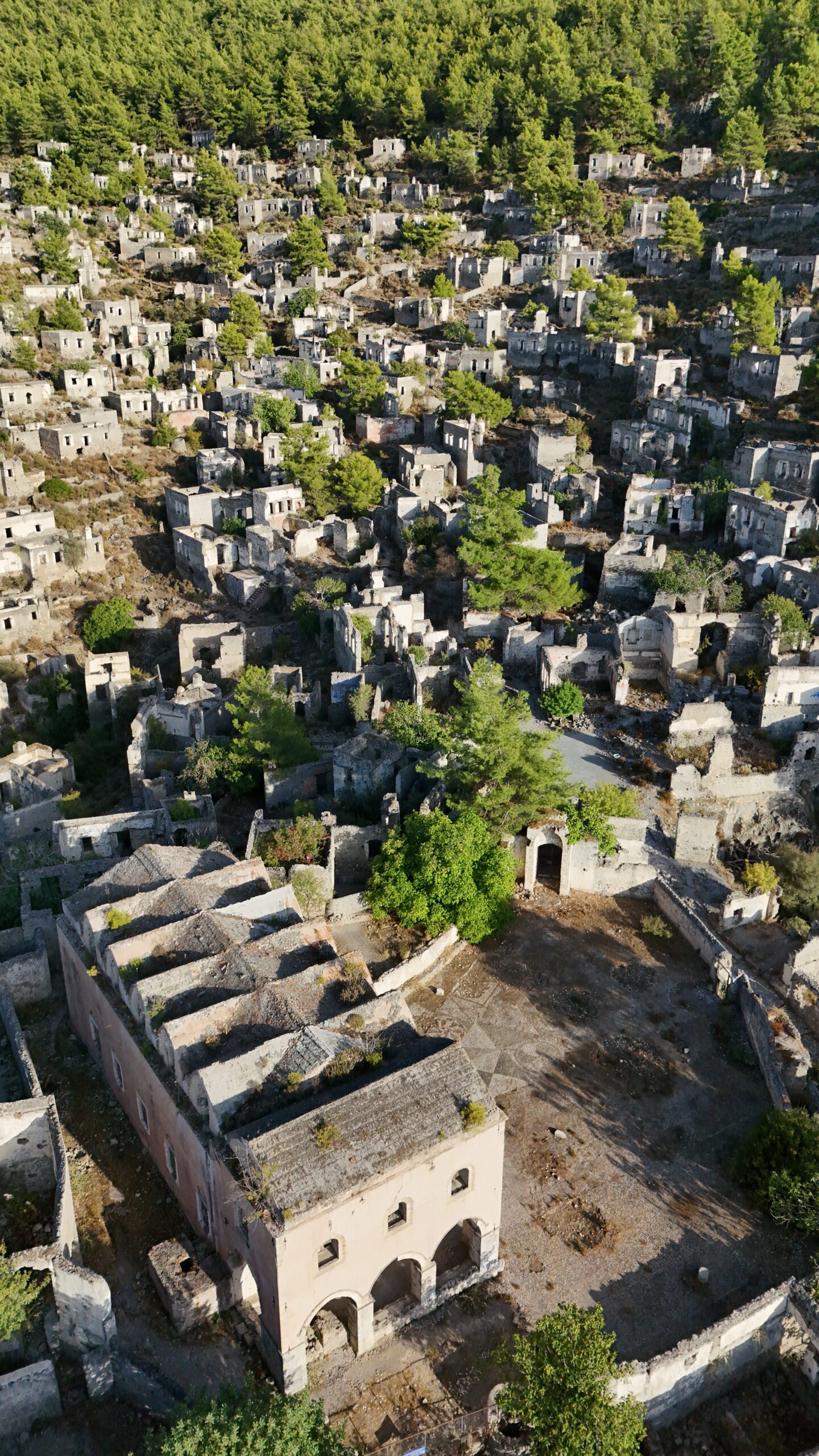
Kayaköy is a village in Turkey’s Muğla province, about 8 km from Fethiye and 9 km from Ölüdeniz, and it holds the country’s most evocative abandoned settlement: hundreds of roofless stone houses climbing the hillside — the remains of Levissi, the Greek Orthodox town emptied by the 1923 population exchange. The ruins are now an open-air museum run by the Ministry of Culture and Tourism and take two to three hours to walk. But Kayaköy is more than ruins. At their foot is a living village; around it run Lycian Way paths, a swimming bay you reach on foot, stone-courtyard restaurants, and a night sky dark enough for the Milky Way. This guide gathers everything you need to plan a visit on one page, with links to our deeper articles under each heading. The people writing it live here; the distances and opening hours are checked on the ground.
In this guide
- Where Kayaköy is and why it matters
- A short history: from Karmylassos to today
- How to get to Kayaköy
- When to go
- What to see: the first seven
- Beaches and bays
- Walks
- Where to eat
- Where to stay
- How long to stay: a sample 3 days
- Practical information: tickets, hours, parking
- Frequently Asked Questions
Where Kayaköy is and why it matters
Kayaköy sits behind the ridge that separates Fethiye from Ölüdeniz, at the edge of a plain ringed by pine forest. Its ancient name was Karmylassos; its Greek name was Levissi. What sets it apart is scale: not a single abandoned lane but the skeleton of an entire town — two churches, scattered chapels, a school building and fountains covering the slope. In the late-afternoon light the stone turns the colour of honey, and directly below the ruins the living village of Kayaköy carries on: vineyards, breakfast gardens, restaurants. Most visitors come over from Ölüdeniz for half a day. Those who stay get the part the day-trippers never see — the silence of the mornings and the depth of the night sky.
A short history: from Karmylassos to today
Levissi was a Greek Orthodox town of thousands, known for its craftsmen, through the nineteenth and early twentieth centuries; Turkish farmers worked the plain below, and the two communities lived side by side. In 1923, under the population exchange agreed at Lausanne, Levissi’s Greek inhabitants were sent to Greece. The exchange families who arrived preferred the farmland of the plain to the houses on the slope, so the town stood empty, and the 1957 Fethiye earthquake left most of its buildings roofless. The full story — daily life in Levissi, the days of the exchange, and the village’s afterlife in fiction — is in our article on the full story of 1923.
How to get to Kayaköy
| From | Distance | Time (by car) | Note |
|---|---|---|---|
| Dalaman Airport | 55–60 km | ≈ 1 hour | Private transfer or hire car; a transfer is best for late arrivals |
| Fethiye town | ≈ 8 km | 15 min | Dolmuş from the bus station roughly hourly |
| Ölüdeniz (Belcekız) | 9 km | 15 min | Via Hisarönü; or on foot along the Lycian Way, 1.5–3 hours |
| Hisarönü | 3 km | 5–7 min | A forest road drops into the village |
| Göcek | ≈ 35 km | 40 min | Via the D400 |
Without a car, the simplest route is the Kayaköy dolmuş from Fethiye bus station; the last departures are early in the evening, so confirm the return time during the day. You do not need a car for the village itself; you do if you want a beach every day. Step-by-step directions, parking and taxi notes are in every way of getting here.
When to go
The short answer: mid-September to the end of October. The sea is still warm (22–24 °C in October), the ruins can be walked at any hour and the crowds have gone. The second-best time is May, when the hills are in flower. In July and August daytime highs reach 34 °C, so walk the ruins between 08:30 and 10:30 or after 17:00. April and November are surprisingly good with a heated pool and underfloor heating. The month-by-month table of temperatures, sea and crowds is in our month-by-month guide — and for UK travellers, the October half-term lands in the best fortnight of the year.
What to see: the first seven
- The ruins of Levissi. There are two entrance gates; entering low and climbing lane by lane is the best route. Allow 2–3 hours.
- The upper church and its view. The climb is steep, but the reward is the whole town and the Kaya plain at your feet. The churches are kept locked for protection; you walk the facades and courtyards.
- The lower church and the chapels. The town’s main church and the small chapels scattered across the slope; traces of fresco can be seen from outside.
- Af Kule Monastery. About 3 km from the village, a monastery carved at the edge of a cliff, reached by a short, steep path. A famous sunset spot.
- Cold Water Bay (Soğuk Su Koyu). A clear, undeveloped bay reached by a 30–40 minute forest path from the ruins.
- The village square and the breakfast gardens. Village breakfast in the morning, stone-courtyard dinners at night.
- The night sky. Far enough from Fethiye’s lights that the stars come back in numbers towns forget.
Horse riding, the village market, cycling and the rest are in all fifteen things to do.
Beaches and bays
Kayaköy has no beach of its own; the nearest swim is Cold Water Bay, on foot. Fifteen minutes by car bring you to Ölüdeniz (Belcekız), Kıdrak and Gemiler Bay; by boat you reach Gemiler Island, Butterfly Valley and Kabak. An early swim at Ölüdeniz, an afternoon at Gemiler, an evening back in the village — that is the rhythm our guests settle into. Distances, access and a “which bay for whom” table are in the beaches and bays near Kayaköy.
Walks
The official start of the Lycian Way is in neighbouring Ovacık, but one of the most-walked opening sections of the route passes through Kayaköy. The Kayaköy–Ölüdeniz path is 5–7 km, moderate, and takes 1.5–3 hours depending on pace; the first view of the sea opens suddenly where the trail crosses the ridge. Kayaköy–Gemiler (≈5 km) and the short, steep Af Kule path are the other two classics. Waymarks, water, footwear and seasons are covered in the path down to Ölüdeniz.
Where to eat
Kayaköy’s kitchen is set in stone courtyards: village breakfast, wood fires, local olive oil, goat’s cheese and bitter orange. The village also has wine houses and grill restaurants that keep the local cook-it-yourself tradition alive. Our own restaurant, KÁRMI, is open from 13:00 to 22:00 with a menu built on local produce, and welcomes outside guests as well as villa guests. Everything from breakfast to dinner is gathered in where to eat in the village.
Where to stay
Nobody sleeps among the ruins — the site is a museum. Accommodation is in the living village at their foot and around its edges: boutique hotels, pensions, restored stone houses and private-pool villa stays. Stay in the village for quiet and history, in Ölüdeniz to walk to the beach, in Hisarönü for nightlife. The area-by-area comparison and the pros and cons of each type of stay are in where to stay in Kayaköy. We host guests on the quiet side of the village in seven restored stone villas, each with a private pool and underfloor heating; we welcome guests aged 13 and over, and pets are welcome too — details on Our Villas.
How long to stay: a sample 3 days
Half a day is enough for a visit; living the village takes three to four nights. A sample three days: Day 1 — arrive, walk the ruins in the late-afternoon light, dinner in a stone courtyard. Day 2 — an early swim at Ölüdeniz, an afternoon boat to Gemiler, sunset back in the village. Day 3 — the Lycian Way walk down to Ölüdeniz, lunch at Belcekız, Cold Water Bay on the way back. Add a fourth day for Saklıkent Gorge and the ruins of Tlos. The hour-by-hour version, a car-free option and evening suggestions are in a three-day plan.
Practical information: tickets, hours, parking
- Opening hours: summer season (1 April – 31 October) 08:30–19:30; winter 08:30–17:30. The ticket office stops selling about half an hour before closing.
- Tickets: the Turkish MüzeKart is valid for Turkish citizens; foreign visitors pay a small entrance fee (check the current price at the gate or on official channels).
- Parking: free areas near the main entrance; they fill on summer middays, so come early.
- Bring: water, a hat, closed shoes (the stone is slippery), sunscreen in summer.
- Accessibility: the lanes are rough stone with steps; beyond the lowest section they are difficult with a pushchair or wheelchair.
- Money and signal: ATMs in the village are limited; most restaurants take cards. Mobile signal is generally good.
- Drones: unauthorised drone flights over the site are prohibited.
Frequently Asked Questions
Where is Kayaköy?
Kayaköy is a village in the Fethiye district of Muğla province, on Turkey’s south-west coast: about 8 km from Fethiye town, 9 km from Ölüdeniz, 3 km from Hisarönü and 55–60 km from Dalaman Airport. It sits behind the ridge between Fethiye and Ölüdeniz, on a plain ringed by pine forest.
Is Kayaköy worth visiting?
Yes. The ruins of Levissi are Turkey’s most evocative abandoned settlement and justify the trip on their own; add the Lycian Way walk, Cold Water Bay, a Gemiler boat day and the stone-courtyard restaurants, and a half-day visit turns into a three- or four-night slow holiday.
What is Kayaköy known for?
Kayaköy is known as Turkey’s “ghost village”: the stone remains of Levissi, a Greek Orthodox town of thousands emptied by the 1923 population exchange and damaged by the 1957 earthquake. It is protected as an open-air museum, inspired Louis de Bernières’s novel Birds Without Wings, and is a gateway to the Lycian Way.
How long does it take to see Kayaköy?
Walking the ruins at an easy pace takes 2–3 hours; with the climb to the upper church and photo stops, half a day is more realistic. In summer the comfortable windows are 08:30–10:30 and after 17:00; in spring and autumn you can walk the site at any hour.
Is there an entrance fee for Kayaköy?
Yes. Turkish citizens enter with the MüzeKart; foreign visitors pay a small fee — check the current price at the ticket office or on official channels. The site is open 08:30–19:30 in the summer season and 08:30–17:30 in winter.
How far is Kayaköy from Ölüdeniz?
Nine kilometres by road — about 15 minutes by car via Hisarönü. Walkers can take the Lycian Way path instead: 5–7 km and 1.5–3 hours depending on pace. The distance is what makes the morning-beach, evening-village rhythm work.
Can you stay in Kayaköy?
Yes. There is no accommodation among the ruins themselves, but the living village at their foot has boutique hotels, pensions, restored stone houses and private-pool villa stays. For couples after quiet, a serviced stone villa on the calm side of the village is the most balanced choice.
Is Kayaköy suitable for couples?
Very. Quiet, history, sunset spots, stone-courtyard dinners and adults-only places to stay make Kayaköy the first address in the region for honeymoons and anniversaries. Couples who want nightlife will be happier in Hisarönü or Fethiye town.
Conclusion
You can fit Kayaköy into an afternoon, but the village saves its morning light and its night silence for the people who stay. Deepen your plan through the links in this guide: the history, getting here, when to come and where to stay. And if you would like to live it as a few mornings rather than a day trip, our stone villas and KÁRMI’s table are here: reservations.